


AI readiness surveys tend to focus on two surface-level metrics: how employees feel about AI, and whether they trust it enough to use it. If both numbers are positive, the assumption is that employees are ready for adoption.
But the data tells a different story.
I wanted to understand how workers in high-stakes settings were using AI in ways tied to valuable outputs, and what was actually driving that use, so I looked at healthcare and coded and analyzed their interviews using the Anthropic Interviewer dataset (Handa et al., 2025). This is a large-scale, publicly released dataset of 1,250 professional interviews tracking how AI is being incorporated into real-world occupational tasks across the economy, available at huggingface.co/datasets/Anthropic/AnthropicInterviewer.
Here’s what I found:
92% expressed positive sentiment toward AI. 69% demonstrated high self-reported reliance on it. And not one individual expressed full trust in AI’s accuracy.
Positive sentiment. High use. Zero full trust.
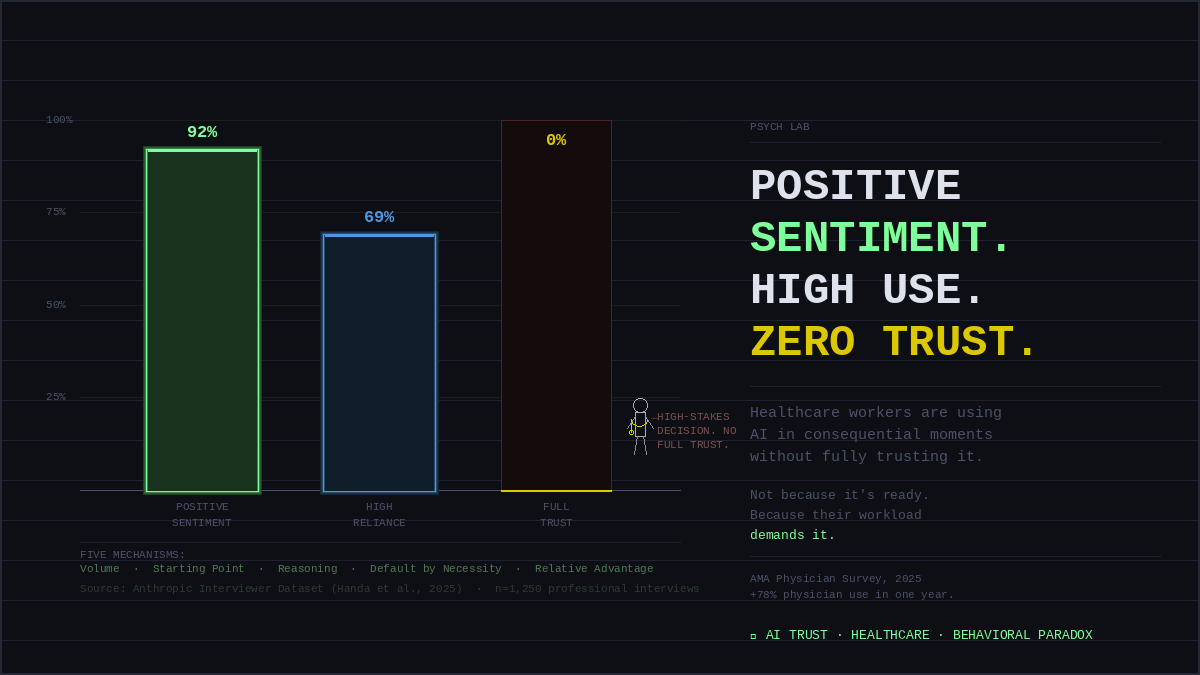
This is the behavioral paradox at the center of human-AI collaboration: if trust is a prerequisite for adoption, why are people relying on systems they don’t fully believe?
The clinical professionals in this sample (nurses, therapists, pharmacists, paramedics, physical therapists, and medical coders) are not a fringe group of early adopters. They’re people managing real caseloads under significant pressure, and they are using AI in consequential moments: checking a medication interaction with a patient already in the room, generating treatment plan objectives before a session, and navigating a knowledge database during a live call.
At first glance, the healthcare population looks like an adoption success story. They feel good about AI and they’re using it at high rates — but they don’t actually trust it, and the reasons they give in interviews have nothing to do with reliability.
If positive sentiment and trust aren’t driving human-AI collaboration, what is?
The Five Mechanisms of Human-AI Collaboration
These five patterns emerged from reading the interview transcripts. They are descriptions of what people actually said when asked why they use AI in their work.
Volume. The workload feels unsustainable without AI. One speech-language pathologist put it plainly: if AI can generate 15 usable items, they only need to produce 10 themselves. A canine rehabilitation therapist cut post-session documentation from 40 minutes to 5. In this context, AI is structurally load-bearing — acting as external working memory to manage cognitive overflow.
Starting Point. People use AI to avoid the friction of starting from zero. “I just need a starting point” was one of the most common phrases across the clinical transcripts. AI gives raw material to react to, not a finished conclusion, lowering the cognitive barrier to entry.
Reasoning. AI functions as an external reasoning partner. A clinical coder described using AI not to get the answer — “I know it’s probably going to be wrong” — but to move their own thinking forward. “AI helps me converse with my own thoughts,” they said. The individual retains executive judgment while AI extends the cognitive workspace — creating a genuine human-AI collaborative workflow.
Default by Necessity. In high-stakes work with competing priorities, AI fills gaps left by unavailable colleagues and inaccessible systems. A pharmacist facing a real-time decision with a patient already at the counter — and no way to reach the prescriber for at least a day — turned to an LLM not out of preference, but because nothing else was available in that moment. It becomes a behavioral workaround for broken organizational architecture.
Relative Advantage. AI is better than what came before — Google in some cases, a clunky database in others. An OR nurse described reaching for AI when Google couldn’t surface a fast enough answer. A Medicare call center worker described AI surfacing policies that were previously buried too deep to find. A tool doesn’t need to be perfectly trusted to win. It just needs to offer less friction than the alternative.
What unites these five mechanisms is that none of them require trust. They require utility. And utility is evaluated relative to existing conditions like workload, time pressure, and available alternatives. This is what effective human-AI collaboration actually looks like in practice — not a confident handoff to a trusted system, but a pragmatic, iterative negotiation between human judgment and machine output.
This isn’t isolated to this sample. The American Medical Association’s 2024 physician survey found 2 in 5 doctors were equally excited and concerned about AI. Yet physician use still jumped 78% in a single year — from 38% in 2023 to 66% in 2024 (American Medical Association, 2025).
The takeaway? People are using AI not because “readiness” has landed, but because their workload demands it. And the organizations that understand this; that human-AI collaboration is driven by utility, not sentiment, will be the ones that design for it deliberately rather than waiting for trust to catch up.
#HumanAICollaboration #FutureOfWork #AIAtWork #OrganizationalPsychology #AIstrategy