


Darwin would have a lot to say about why AI is thriving in some parts of organizations and not in others.
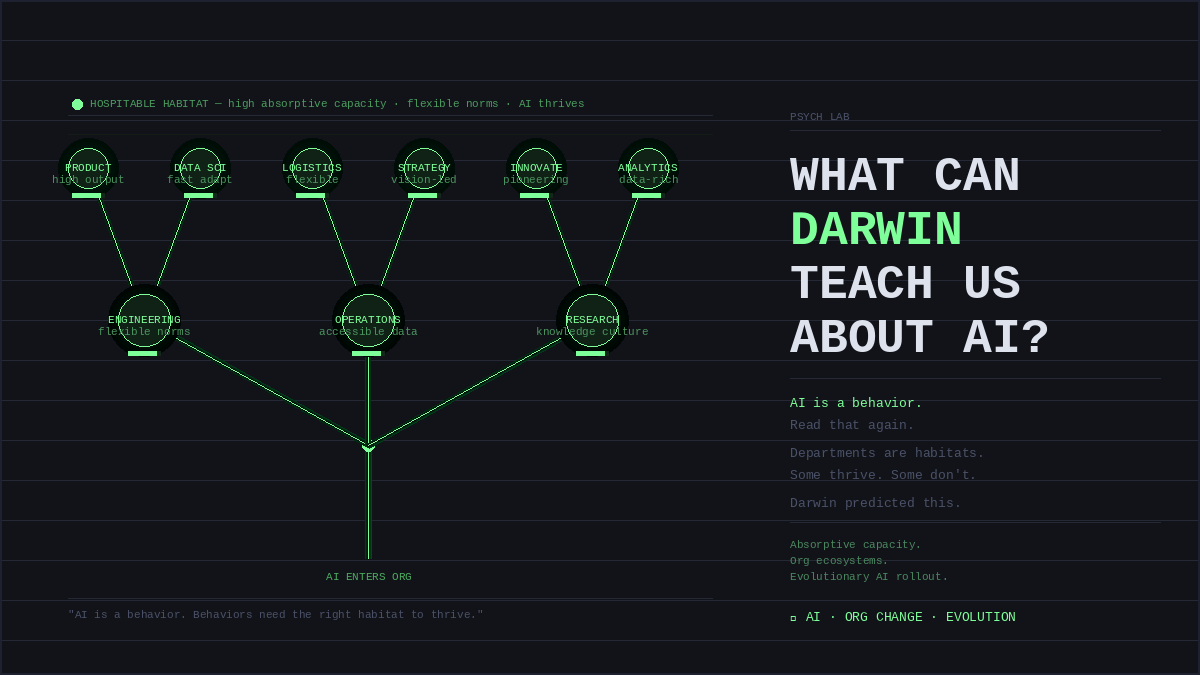
To begin, organizations across industries are treating AI rollouts like software rollouts, but AI isn’t a static tool. AI is a behavior. Read that again, AI is a behavior. It requires behavioral change (habit change!) by users over time for it to be integrated+ adapted into daily work. Even more importantly, for people to metabolize the massive amount of knowledge AI generates and create valuable outputs from it.
So if everyone has access to AI, and has the training, and received the messaging… but AI adoption lacks real depth, what then?
This is where we learn from Darwin’s evolutionary theory. In this lens, AI is a new “species” entering an organization’s ecosystem, and just like any pioneering species, it’s looking for the most hospitable habitat to thrive. Low resistance. Available resources. An environment that allows it to metabolize and grow. In an organization, habitats = departments.
Some departments are hospitable habitats for AI: flexible norms, accessible data, a culture that knows what to do with a massive influx of new knowledge. These departments have high “absorptive capacity’”; they metabolize AI’s knowledge and generate valuable outputs overtime.
Others are inhospitable. Rigid rules, firewalls, workflows built for predictability + legacy systems. AI doesn’t integrate and thrive there because the habitat isn’t ready, yet.
What’s exciting is what emerges from where AI thrives, which is a map of high-use departments. This emerging organizational map is key to seeding + testing future technology, including agentic AI.
Lastly, it all comes back to one idea that I think gets missed: AI isn’t a tool. It’s a behavior. And behaviors don’t follow software rollout logic.
#AI #OrganizationalBehavior #ArtificialIntelligence #Research