


We talk far more about layoff anxiety than about what’s slowly happening to the middle of the organizational chart. This is the more urgent and interesting story, one that centers on the freezing of middle management: a group stranded in a “career cul-de-sac” and opting to stay there.
Beyond layoffs, there’s an even louder signal: the extinction of the entry-level jobs that have traditionally fed into middle management, and what that portends for those already there. For a middle manager, playing the long game now requires upskilling in AI; something the data suggests they are actively resisting.
So if this is true, if the frontier AI boom is freezing middle management unless they upskill, why haven’t the alarm bells sounded more urgently?
This piece is organized around two questions:
Why have we not heard more about the freezing of middle-management careers, and when will that change?
Has AI eliminated the entry-level roles that fed into those middle-management positions, and have new, AI-native entry-level roles emerged to take their place?
A correlation worth examining
In a longitudinal analysis of workforce search behavior between 2021 and 2026, a consistent pattern emerges (see chart below: The Crossover). Two distinct anxieties have risen in parallel: fear of AI displacement and fear of career stagnation. The two lines track two different search behaviors: the green is the AI-Labor-Market group, queries about AI roles, AI skills, and “jobs replaced by AI.” The orange is the Career-Stagnation group, “career plateau,” “stuck in my career,” “dead-end job,” and coaching or transition terms.
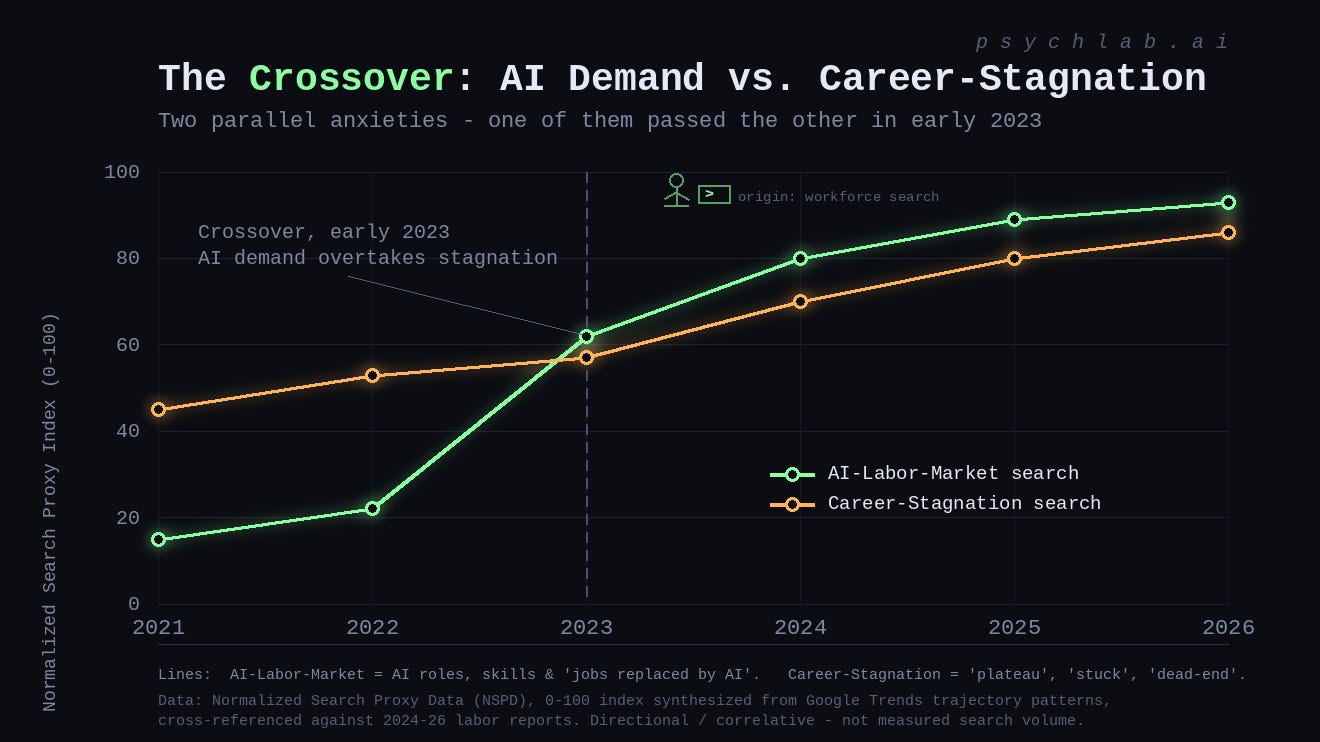
In 2023 there is an inflection: AI job queries accelerate sharply to create that green-line hockey-stick shape in the chart, and in parallel, searches associated with stagnation (”career plateau,” “stuck in my career,” “dead-end job,” and coaching or transition terms) also climb. What had been background drift becomes a sustained ascent that tracks AI demand closely.
The dominant response for mid-career professionals facing AI exposure is a search for exit. The most active terms cluster around coaching, transition, and survival rather than upskilling. This is arguably interesting in itself, because upskilling takes quite a bit of effort. Professionals appear to be expressing displacement anxiety by looking for a way out, not a way in, starting in early 2023 and reaching a peak in 2026, the most recent point in the series.
Evidence that the lower rungs have thinned
Next is our question about the mystery surrounding entry-level roles feeding these middle management roles, and whether they’re being replaced with new AI jobs.
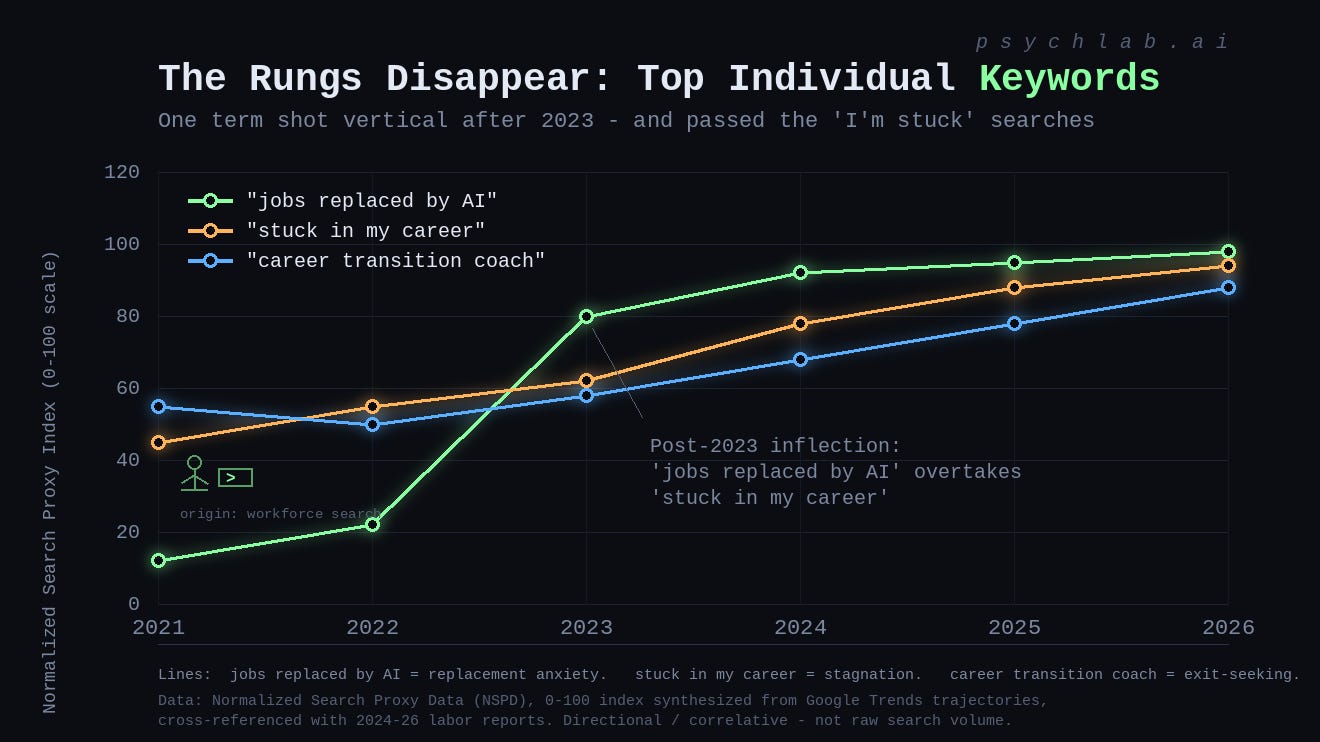
Look at the chart, The Rungs Disappear, and the line, “jobs replaced by AI.” It surpasses “stuck in my career” in 2023, which indicates replacement-oriented anxiety overtaking immobility-oriented anxiety. In short, people stopped worrying about being passed over and started worrying about being phased out. The fear shifted from “I can’t move up” to “I can be replaced.” The worry changed from “my career isn’t going anywhere” to “my role might not exist much longer.”
Using payroll records from ADP, Brynjolfsson, Chandar, and Chen (2025) document a roughly 13% relative decline in employment for workers aged 22 to 25 in the most AI-exposed occupations since late 2022, even as employment for older workers in the same occupations held steady or rose. Recent worker-flow evidence on labor-market polarization is at minimum consistent with this kind of hollowing (Atlanta Fed, 2026). When the first rung of the career ladder, the entry-level “starter” roles where junior workers historically learned the job, is removed, the result is not an abrupt collapse but a ladder missing its base. This means that the people already in middle management have no pipeline rising up beneath them and no obvious rung to step onto above, so they stay exactly where they are. The freeze is not caused by a single layoff event; it is caused by the quiet removal of movement on both sides of them.
On the second half, whether new AI-native entry-level roles have taken their place, the honest answer is: not yet, and not symmetrically. Projections of net job creation do exist. The World Economic Forum (2025) estimates that AI and related shifts could displace 92 million roles by 2030 while creating 170 million new ones, a net positive on paper. But three caveats matter for the mid-career question. First, the timing is mismatched: displacement is measurable now, while creation is projected and lagging (Brynjolfsson et al., 2025). Second, the new roles, AI oversight, model evaluation, and human-AI coordination, are not one-for-one substitutes for the vanished rungs; they demand different skills and sit in different parts of the org chart (World Economic Forum, 2025; Cazzaniga et al., 2024). Third, the IMF estimates that roughly 40% of global employment is exposed to AI, with advanced-economy white-collar tracks, exactly the feeder roles for middle management, among the most exposed (Cazzaniga et al., 2024). So the rungs are being relocated, narrowed, and repriced. For the existing mid-career manager, a new entry-level role in model oversight three teams over is not a ladder they can climb; it is a different ladder entirely.
The appropriate metaphor, then, is not a cliff but a cul-de-sac: movement slows to a stop without any single dramatic event to mark it.
Why the alarm has not yet spread
A freeze is structurally less visible than a layoff. Layoffs generate discrete events, a date, a notification, a public status change, and discrete events propagate efficiently through social networks because each is a vivid, shareable signal. More importantly, alarm tends to require reinforcement: people update toward a new and uncomfortable belief when they receive the same signal from several independent sources they trust. This is the logic of complex contagion, in Damon Centola’s landmark research, where certain beliefs and behaviors spread after multiple overlapping confirmations from different sources, rather than a single exposure (Centola, 2018).
A middle-management freeze does not create any “social contagion” or social burst where there would be a media frenzy on the topic. There is no event to share, no date to point to, and, critically, no easy way to distinguish a personal plateau from a systemic one. An individual experiences a stalled trajectory privately and cannot readily tell whether colleagues are experiencing the same thing. The signal therefore fails to reach the threshold of reinforced, cross-network confirmation that would let it cascade into collective awareness. The condition can be simultaneously widespread and socially silent: high in prevalence, low in visibility, and lacking the shareable artifact that would trigger a burst of recognition.
That, I think, is the answer to the first question. The freeze has not reached fever pitch because it does not yet produce the kind of repeated, reinforcing signals through which collective alarm actually travels.
When the silence is likely to break
The plausible trigger is the point at which the freeze begins to generate legible events: a wage-compression pattern that becomes widely recognized, or a cohort that arrives, more or less together, at the realization that “upskill to AI or remain frozen” was the operative choice and that the window has narrowed. Once private suspicion becomes a public and repeated signal, the threshold for complex contagion can be met, and such contagions, once established, tend to spread rapidly.
For founders and policymakers, the structural implication deserves emphasis. Agentic systems cannot be integrated effectively into an organization whose managerial layer is operating in survival mode. Organizational absorptive capacity (knowledge absorption from AI + ROI from AI) resides disproportionately in the very people now oriented toward exit rather than adoption.
BOTTOM LINE: The freeze is not only a workforce concern, but a deployment constraint: the human layer that would need to absorb these systems is the layer currently most disengaged from them.
Lastly, the middle is not being dismissed, but is most certainly parked, which is a quieter condition, and one that tends to go unremarked until a large number of people recognize it at the same moment.
References
Brynjolfsson, E., Chandar, B., & Chen, R. (2025). Canaries in the coal mine? Six facts about the recent employment effects of artificial intelligence [Working paper]. Stanford Digital Economy Lab. https://digitaleconomy.stanford.edu/publications/canaries-in-the-coal-mine/
Cazzaniga, M., Jaumotte, F., Li, L., Melina, G., Panton, A. J., Pizzinelli, C., Rockall, E., & Tavares, M. M. (2024). Gen-AI: Artificial intelligence and the future of work (Staff Discussion Note No. SDN/2024/001). International Monetary Fund. https://www.imf.org/en/Publications/Staff-Discussion-Notes/Issues/2024/01/14/Gen-AI-Artificial-Intelligence-and-the-Future-of-Work-542379
Centola, D. (2018). How behavior spreads: The science of complex contagions. Princeton University Press.
World Economic Forum. (2025). The future of jobs report 2025. https://www.weforum.org/publications/the-future-of-jobs-report-2025/