


The persistent failure of AI adoption initiatives across industries points to a fundamental misunderstanding of AI's nature. AI is not a tool, but rather a behavior, and an entirely new form of intelligence. Unlike software, it cannot be downloaded and deployed across an organization and deliver value. It behaves, adapts, explores, and generates, which puts it in immediate conflict with departments built around consistency and predictability. In this way, the process of introducing AI to an organization mirrors Darwin's theory of evolutionary succession almost perfectly.
Just like in evolutionary succession, a pioneering force like AI establishes itself in environments that are hospitable and offer low resistance. These “environments” in an organization are departments or teams where the norms are flexible (Gelfand et al., 2007) and barriers to use are low. Hospitable habitats are departments characterized by flexible norms and accessible data (Cohen & Levinthal, 1990) that allow AI to establish a foothold and eventually reshape legacy routines. Inhospitable habitats are departments defined by high structural inertia, which is resistance in the form of rigid protocols or locked-off data that prevent AI from taking root. In this framework, the future of work is reshaped through hospitable habitats first, because they are most capable of absorbing and acting on the knowledge AI introduces. Departments like research and communications have high potential because of their appetite for knowledge and tolerance for experimentation. Other areas will be slower to follow, their norms shifting gradually under the pressure that high-metabolizing areas place on the broader organization.
To foster this process and accelerate AI adoption, leaders must move past static organizational charts and legacy processes, and recognize the newly emerging organizational structure created by what functions AI best inhabits. This emergent map of systemic norms is called The Topography of AI.
Mapping the AI Adoption Landscape: A Topography of AI in the Workplace
To navigate this evolutionary succession, leaders need a diagnostic tool to identify where AI will naturally thrive and where it will stall. We call these functions or departments, “habitats”. The Topography of AI categorizes these organizational habitats along two critical dimensions:
1. Tightness-Looseness (Gelfand et al., 2007): This dimension measures the strength of operational norms and the tolerance for deviation. “Tight” departments rely on strict rules and predictability, while “loose” departments encourage flexibility and experimentation.
2. Absorptive Capacity (Cohen & Levinthal, 1990): This is a habitat’s ability to recognize the value of new information, assimilate it, and apply it to productive ends. In the context of AI, high absorptive capacity means a habitat has the accessible data and the technical readiness required to metabolize new intelligence.
By crossing these two axes, we identify four distinct habitats: The Innovation Garden (Loose/High Capacity), The Precision Engine (Tight/High Capacity), The Fragmented Sandbox (Loose/Low Capacity), and The Compliance Fortress (Tight/Low Capacity). These dictate how AI integrates into the legacy ecosystem.
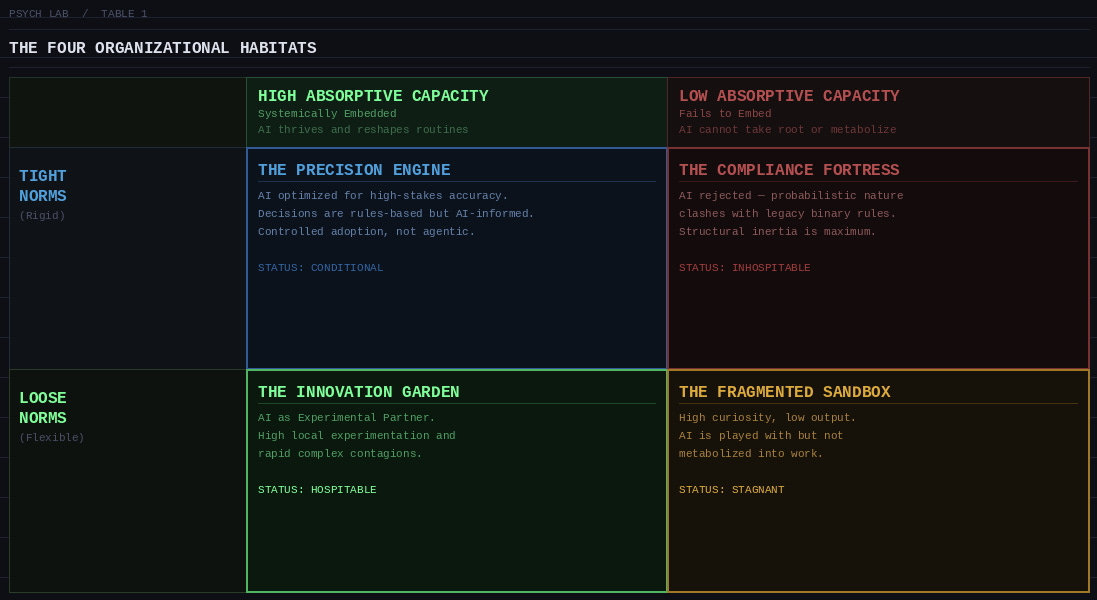
The Four Organizational Habitats:
The Innovation Garden (Hospitable): This is the ideal starting point for evolutionary succession. With flexible norms and accessible data, the Garden is highly hospitable. AI establishes an immediate foothold here, acting as an experimental partner that quickly metabolizes legacy routines and creates new, highly efficient processes.
The Compliance Fortress (Inhospitable): This habitat is defined by maximum structural inertia. Rigid protocols and locked-off data make it entirely inhospitable. The Fortress rejects the probabilistic nature of AI, viewing it as a threat to systemic reliability rather than an asset.
The Precision Engine (Conditional): In this habitat, the norms are tight, but the absorptive capacity is high. AI is adopted here, but it is not allowed to freely reshape routines. Instead, it is strictly constrained and optimized for high-stakes accuracy, serving as a powerful but highly controlled calculator rather than an agentic force.
The Fragmented Sandbox (Stagnant): Here, the norms are loose and curious, but the habitat lacks the data architecture and readiness to actually metabolize the intelligence. AI is frequently “played with” in the Sandbox, but these isolated experiments never translate into structural change or operational value.
The Dynamics of AI Adoption: Behavior Change and Organizational Performance
Once AI establishes a foothold in the Innovation Garden, it begins to spread. To understand why AI first takes hold in this habitat, we look at behavior change.
According to the Fogg Behavior Model (Fogg, 2009), a new behavior only occurs when three elements converge at the exact same moment: Motivation, Ability, and a Prompt. The Innovation Garden provides the perfect conditions for this convergence.
First, motivation is naturally high due to the department’s loose norms and inherent drive for experimentation. Second, ability is high because the habitat possesses strong absorptive capacity, meaning data is accessible and the team is equipped to use it. Finally, the technology itself acts as the prompt. Because AI is agentic rather than static, it actively invites interaction through conversational interfaces and predictive suggestions.
When these three elements align, the Innovation Garden digests and embeds the new intelligence into daily workflows. This creates a surge in knowledge output and what we call metabolic efficiency. The department begins processing information faster, generating superior outputs, and operating at a new baseline of speed and scale.
However, this localized success can lead to an ecological imbalance within the broader organization. The hyper-productive Innovation Garden can exert performance pressure on adjacent habitats. As the Garden accelerates, the Precision Engine and the Compliance Fortress suddenly appear remarkably slow, rigid, and resource-heavy by comparison.
This performance pressure is the natural process behind evolutionary succession. The Compliance Fortress can no longer justify its structural inertia when a neighboring department is achieving exponentially better results. To survive this ecological shift, the Fortress is forced to adapt. It must either increase its absorptive capacity by unlocking its data, or it must loosen its rigid norms to allow for new workflows. It must evolve to accommodate the new intelligence, or risk having its legacy routines replaced by the newly emerging organizational structure.
Leadership Imperatives: Shaping Your AI Adoption Strategy
To lead an organization through evolutionary succession, leaders must shift from “system administrators” to “habitat cultivators.” Using the Topography of AI as a map, leaders can take the following actions to cultivate the best ecosystem possible for AI:
1. Target the Habitats of Least Resistance: Do not attempt a simultaneous, organization-wide AI rollout. Identify the Innovation Gardens and seed them first. These habitats are the natural early adopters of the topography, and their successful engagement is vital for seeding the S-curve (Catalini & Tucker, 2017). These early adopters are individuals with deep ties in local networks who act as opinion leaders and technology pioneers while facilitating social learning among their peers. By allowing these habitats to establish a foothold first, leaders create the “proof of performance” necessary to break the structural inertia of more rigid habitats.
2. Prioritize “Ability” Over “Motivation”: Traditional training often tries to talk people into wanting to use AI. The more effective strategy is reducing friction within the habitat. Instead of requiring employees to navigate away from their primary tasks to find the AI, leaders should embed it directly into existing day-to-day tools by using browser extensions, integrated icons, or automated plugins so that accessing AI is seamless. The principle is simple: when the tool is placed at the point of need, using it becomes the path of least resistance (Fogg, 2009).
3. Build “Wide Bridges” to the Fortress: The Compliance Fortress cannot be motivated into change through simple pressure. It must be brought into the succession process through wide bridges. Unlike a narrow bridge where only one person shares an idea, a wide bridge consists of multiple, overlapping connections between two different groups. These bridges are vital for “complex contagions”, which are behaviors that require multiple sources of social reinforcement before they are adopted (Centola, 2018). This is because people usually require confirmation from several different peers before they feel safe enough to change their behavior. Design cross-functional teams where “Gardeners” demonstrate utility and “Fortress Guards” design the governance. This multiple-tie approach makes the shift feel like a shared movement rather than a risky individual choice.
4. Design for Imprinting: Imprinting occurs during a brief sensitive period when an organization is uniquely receptive to new foundational norms and roles (Marquis & Tilcsik, 2013). This period represents a high-stakes window to shape the organizational topography before behaviors become rigid and locked in. For an AI-integrated environment to become systemically embedded, these habits must be fostered and encouraged as the new norm during this sensitive period. What takes root now becomes the baseline of the emergent norms, the foundation of the Topography of AI.
Conclusion: Building an AI-Ready Organization
The persistent failure of AI adoption is a challenge best understood through the evolutionary dynamics of an organizational environment. When organizations treat AI as a static tool, they ignore the dynamic, agentic nature of the technology and the behavioral habitats required for it to thrive. By shifting our perspective to the Topography of AI, we can begin to see why top-down mandates fail and why localized pockets of success occur.
The future of work will be defined by who can most effectively allow for the technological and cultural evolution of an organization. Leaders who recognize their departments as distinct habitats and who use the mechanics of behavior to cultivate them will create organizations that are more than just automated. They will create organizations that are metabolically efficient, capable of digesting vast amounts of intelligence, and ready to inhabit the new landscape of the digital age.
#AIAdoption #Futureofwork #AIStrategy #Leadership #OrganizationalChange #AgenticAI #Innovation
References
Catalini, C., & Tucker, C. (2017). Seeding the S-Curve? The Role of Early Adopters in Diffusion. NBER Working Paper No. 22596.
Centola, D. (2018). How Behavior Spreads: The Science of Complex Contagions. Princeton University Press.
Cohen, W. M., & Levinthal, D. A. (1990). Absorptive Capacity: A New Perspective on Learning and Innovation. Administrative Science Quarterly, 35(1), 128-152.
Fogg, B. J. (2009). A Behavior Model for Persuasive Design. In Proceedings of the 4th International Conference on Persuasive Technology (pp. 1-7).
Gelfand, M. J., Erez, M., & Aycan, Z. (2007). Cross-cultural organizational behavior. Annual Review of Psychology, 58, 479-514.
Marquis, C., & Tilcsik, A. (2013). Imprinting: Toward a Multilevel Theory. The Academy of Management Annals, 7(1), 195-245.