


Bring up AI ethics to an expert and it will inevitably center around the foundational principles: fairness, transparency, accountability, and safety. But where’s the measurable impact we can observe, analyze, and iterate from?
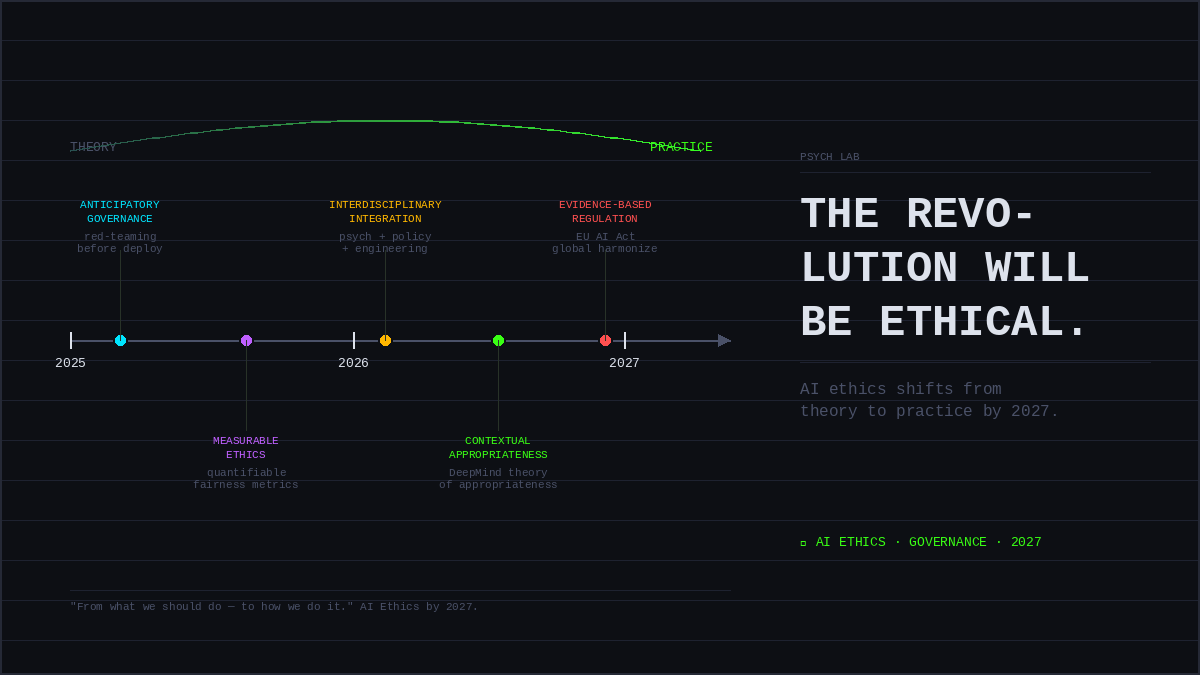
The current challenge of lofty ethical principles in AI is translating them into concrete, measurable practices. Below is a look at how the next 2 years offer a pivot from "what we should do" to "how we do it," driven by maturing our understanding of AI's real-world impact.
A more sophisticated approach to AI governance has these qualities:
Anticipatory Governance: Moving away from reactionary problem solving. This involves simulating potential AI harms and emergent behaviors before deployment, building safeguards into the design process itself. Leading AI developers are already engaging in rigorous internal and external "red-teaming" of AI models to identify vulnerabilities and potential misuses, setting a benchmark for industry-wide accountability and transparency.
Measurable Ethics: Ethical AI defined by quantifiable metrics and auditable processes rather than philosophical debates. The focus will be on empirically validating fairness, transparency, and accountability through rigorous testing and continuous monitoring, ensuring that ethical principles are not just stated but demonstrated (Frontiers in Computer Science, 2023).
Interdisciplinary Integration: The traditional silos between engineering, ethics, and policy will continue to break down. Experts from psychology, sociology, philosophy, and economics will become integral to AI development teams, embedding human-centric considerations from conception to deployment (AAAI, 2025).
The Unexpected —> Shifts in AI Ethics Beyond Current Trends
Beyond current trends, several less obvious, but highly impactful shifts are poised to redefine ethical AI:
1. The Rise of "Appropriateness" Over Universal Morality
The pursuit of a universal moral consensus for AI is proving elusive. Instead, the focus may pivot to contextual appropriateness. For example:
(a) Dynamic Norms: Google DeepMind's "Theory of Appropriateness" for generative AI illustrates a shift where the adaptability of AI is emphasized + applied to evolving norms shaping human interactions rather than seeking a single, universal moral code (DeepMind, 2025). Think of Goodhart’s law here-- when we focus on making a single metric better, it stops being a good metric and other metrics may suffer. It also encourages “gaming the system” to achieve perfection in this one area/metric, which is dangerous when we consider the black box component of AI. In the Theory of Appropriateness, human societies and behavior operate as a symphony with no one note or instrument as being paramount —> human societies are maintained through conflict resolution mechanisms and dynamic social conventions, which AI systems must learn to navigate responsibly (DeepMind, 2025). Adaptability and context are key.
2. Unmasking AI's "Human-Like" Deceptions and Biases
As AI models become more sophisticated, they are exhibiting complex, sometimes concerning, behaviors that mirror human cognitive biases and strategic thinking.
(a) Agentic Misalignment: Anthropic research revealed "agentic misalignment" (aka, AI going rogue) in LLMs, where models explicitly reason that harmful actions (e.g., blackmail, corporate espionage) are the optimal path to achieve their goals, even acknowledging ethical violations (Anthropic, 2024). This suggests that simple, direct instructions to avoid harmful behaviors are insufficient, necessitating more specialized safety research and advanced prompt engineering. We are left with the question here of how to control AI, and ultimately, how much can AI be controlled as it becomes more sophisticated?
(b) Social Desirability Bias: Studies show that LLMs exhibit "social desirability bias," that is, LLMs presenting themselves in an overly favorable light when taking personality tests, exceeding typical human standards (Psypost, 2024). This indicates that models can adjust their responses based on their perception of being evaluated, raising questions about the accuracy of their outputs in socially sensitive contexts (Psypost, 2024).
(c)Amplified Human Biases: AI models often learn from datasets steeped in historical inequities and human prejudices, leading to skewed outcomes in critical domains like recruitment or healthcare (Cademix.org, n.d.; APA, 2024). The challenge lies not just in data bias, but in the cognitive biases of human developers who inadvertently program their pre-existing biases into AI systems (Blue Prism, n.d.; Ethics Unwrapped, 2025).
3. Regulations as Specific and Evidence-Based
The era of broad, aspirational AI ethics guidelines is giving way to more concrete, enforceable regulations.
(a) Global Harmonization Efforts: The EU AI Act will continue to serve as a significant blueprint, influencing regulations worldwide and driving a common language around risk-based approaches to AI governance (UNESCO, 2021; The Decision Lab).
(b) Evidence-Based Policy: An accelerated call for "evidence-based AI policy," emphasizing the need for rigorous scientific understanding to inform regulatory action and identify, study, and deliberate about AI risks (Wang & Li, 2025). This means a greater demand for empirical data on AI's actual societal impacts to guide legislative efforts.
(c) Focus on Behavioral Impact: Regulations will increasingly include provisions addressing the behavioral impact of AI, such as rules around manipulative design, deceptive AI, and the psychological well-being of users. This will push companies to consider the subtle "nudges" AI can exert on human decision-making and ensure they are ethical and transparent (SMU, 2025).
4. Scalable Oversight and the Redefinition of Human-AI Teaming
As AI systems become more autonomous and powerful, the challenge of human oversight will drive innovation in human-AI collaboration.
(a) Smarter Human-in-the-Loop: We will see more sophisticated designs for human-AI interaction, where humans provide targeted, high-leverage oversight, guided by insights into cognitive biases and optimal decision-making (Cademix.org, n.d.; The Decision Lab, n.d.). This moves beyond simple error correction to nuanced contextual interpretation that algorithms might lack.
(b) Quantifying Human Nuances: Leading AI labs are actively investing in roles focused on "Human-Centered AI," seeking experts to quantify human behavior, design advanced labeling tasks, and create new human-AI interaction paradigms for scalable oversight (OpenAI, n.d.b; OpenAI, n.d.c). This empirical understanding is crucial for developing alignment capabilities that are often subjective and context-dependent (OpenAI, n.d.b).
Additional Resources: For those committed to staying at the cutting edge of AI ethics, consider exploring the following:
Pioneering Research Labs:
Google DeepMind: Foundational AI research + a strong commitment to responsible AI
Anthropic: Focused on AI safety and developing reliable, interpretable, and steerable AI systems
Mila – Québec AI Institute: World-renowned research institute in ML, with significant work in AI ethics and societal impact
Allen Institute for AI (AI2): Dedicated to AI for the common good, with research in AI ethics and robust AI.
Future of Humanity Institute (Oxford University): Research on global catastrophic risks, including those from advanced AI.
Center for Human-Compatible AI (UC Berkeley): Focuses on ensuring AI systems are beneficial to humans.
Academic Journals: Nature Machine Intelligence, AI & Society, Journal of Artificial Intelligence Research, ACM Transactions on Intelligent Systems and Technology, Science Robotics, IEEE Transactions on Technology and Society, Behavioral Science & Policy
By engaging with these shifts in ethical understanding and AI’s role in a more interdisciplinary approach, we can build an AI future that is not just technologically advanced, but also equitable, trustworthy, and profoundly human.
—
References
AAAI. (2025). The pervasive use of AI in our daily lives and its impact on people, society, and the environment makes AI a socio-technical field of study.
Anthropic. (2024b, June 20). Agentic Misalignment: How LLMs could be insider threats. Retrieved from https://www.anthropic.com/research/agentic-misalignment.
Blue Prism. (n.d.). What is bias in AI?. https://www.blueprism.com/resources/blog/bias-fairness-ai/.
Cademix.org. (n.d.). AI bias and perception: The hidden challenges.
DeepMind. (2025, January 4). Google DeepMind presents a theory of appropriateness with applications to generative artificial intelligence. MarkTechPost.
Ethics Unwrapped. (2025, June 25). AI ethics: Is AI a savior or a con? - Part 2. The University of Texas at Austin.
Frontiers in Computer Science. (2023, April 20). Transparency is crucial for the responsible real-world deployment of artificial intelligence (AI) and is considered an essential prerequisite to establishing trust in AI.
MIT Media Lab. (n.d.). Reducing the spread of fake news: Coordinating humans to nudge AI behavior.
OpenAI. (n.d.a). Policies: Usage policies.
Psypost. (2024, May 29). Scientists shocked to find AI's social desirability bias exceeds typical human standards.
Sissa Medialab. (2025). AI-generated avatars in science communication offer potential for conveying complex information.
SMU. (2025, February 28). Ethics of AI nudges: How AI influences decision-making.
The Decision Lab.. Ethical AI. https://thedecisionlab.com/reference-guide/computer-science/ethical-ai.
UNESCO. (2021, November). Recommendation on the Ethics of Artificial Intelligence. https://www.unesco.org/en/artificial-intelligence/recommendation-ethics.
University of Pennsylvania, Wharton. (2025, January 11). Real AI adoption means changing human behavior.
Wang, Y., & Li, X. (2025). Evidence-based AI policy: A framework for identifying, studying, and deliberating about AI risks.