


Anthropic’s recent evidence review of worker retraining documents a paradox that most coverage missed. American training programs are in high demand. For example, the technology training nonprofit, Per Scholas, received over 70,000 applications for 5,000 seats in 2025. Yet, even with high admission rates, the macroeconomic impacts post-graduation remain small, yielding only about two additional employed people per hundred and roughly $1,000 more in yearly income (Roodman & Massenkoff, 2026). While Roodman and Massenkoff discuss this macroeconomic failure in the Anthropic Economic Index, understanding how to solve this paradox requires looking beyond economics to the cultural components of trust.
Interpersonal Trust vs. Structural Assurance
Fundamentally, retraining in America fails to reflect the American model of trust, and this is where the gap begins. American trust operates as an interpersonal belief that exists between people, which means that trust anchors in an individual. Because the United States is a highly mobile, at-will labor market, assessing interpersonal trustworthiness is mandatory for economic survival. Private entities offering retraining fail to capture the trust of the American worker because these programs lack long-term mentorship and interpersonal relationships. Without a specific individual to anchor trust in, the system fails to convince workers that certification merits the tradeoff of time, effort, and missed opportunities. It also fails to capture the American model of trust.
Crucially, these programs also lack embeddedness within key institutions to extend relationships beyond an employer’s short-term needs. Often the curriculum of soft and vocational skills address near-term needs, but the employer misses out, too. Once their project needs are met, the employer’s absorptive capacity, or the ability to recognize and assimilate new external knowledge, apply it, and experience productivity gains, stagnates. The same structure the employee needs for a long-term vision is also the structure the employer needs to absorb, assimilate, and apply new knowledge. Without a structure to mitigate the friction of social uncertainty, a firm cannot effectively recognize, assimilate, or apply a retrained worker’s new capabilities. A long-term vision or “horizon” is missing for both parties.
Trust operates differently in countries where the social norm is “lifetime employment”. This model reflects a mutual, long-term commitment by both the employee and the employer, with the goal of continual benefit. Companies operating under lifetime employment models typically recruit after graduation and invest in the worker, taking observable actions that “assure” the employee of their commitment. This deepens embeddedness. While several European countries, most notably Italy, France, Spain, Germany, and the Netherlands, protect continuing employment through strict dismissal law, Japan achieves the same stability through norm and structure rather than through law.
Within a “lifetime employment” context, interpersonal trust isn’t needed because the system itself creates an “assurance structure.” Evaluating interpersonal beliefs about who to trust becomes irrelevant to career success. For example, in Japan, lifetime commitment is the expectation and cultural norm, sustained through mutual benefits, a shared long-term vision, and the mutual monitoring of behavior. This structural alignment makes it unusual for a person to leave a firm after it has invested in them. Thus, a Japanese employee leaving an institution violates this baseline assurance and social norm, and may find it difficult to re-enter the labor market.
The Credential Crisis: Reskilling in a “Market for Lemons”
Consider the training certificate from the perspective of the American worker: it represents a promise devoid of personal backing. Neither the worker nor the employer has a trusted, known entity vouching for its validity. Lynne Zucker’s (1986) historical work shows that America built this machinery deliberately: between 1840 and 1920, facing immigration and constant mobility, America replaced relationship-based trust with institutional substitutes, credentials, licenses, and certifications. However, these substitutes only function when supported by an infrastructure of guarantors, much like a medical board capable of revoking a practitioner’s license. Modern retraining certificates entirely lack this structural infrastructure.
This failure mode is rooted in social uncertainty, which emerges when one party has an incentive to oversell and the other cannot verify quality (Yamagishi, Cook, & Watabe, 1998). Kollock (1994) observed this dynamic in Southeast Asian markets: rice, whose quality is visible upon inspection, trades between strangers in open markets, while rubber, whose quality is knowable only after processing, trades inside committed relationships that last generations. A worker’s skill is rubber. An employer cannot inspect a certificate and know its quality. Furthermore, America’s training providers historically possessed every incentive to oversell, creating a legacy of “fly-by-night” operators that conditioned employers to be suspicious (Roodman & Massenkoff, 2026). The result is Akerlof’s (1970) market for lemons: employers discount every certificate toward the value of the worst, and the market for credentials slowly unravels.
Assurance: Japan’s construct of trust in employment
Lifetime employment, enterprise unions, and long-term supplier networks (keiretsu) make commitments costly to break while rendering defection easy to observe. Within these structures, a firm trains its own workers without hesitation because low turnover guarantees the firm captures the investment returns. A certificate granted inside an assurance structure reinforces this commitment. Because the issuer and the hirer are structurally bound together, the certificate inherits the network’s overarching credibility. The anchor of trust remains embedded in the institution rather than the individual. In laboratory trading experiments, Japanese and American participants facing identical conditions formed committed relationships at identical rates. Notably, when monitoring and sanctions were removed, Japanese participants actually defected at higher rates than Americans (Yamagishi, Cook, & Watabe, 1998). The cooperation historically attributed to Japanese culture is not internalized virtue or a fixed belief system. It is entirely a product of the assurance structure, proving that such cooperative frameworks can be engineered anywhere.
The Replication Crisis
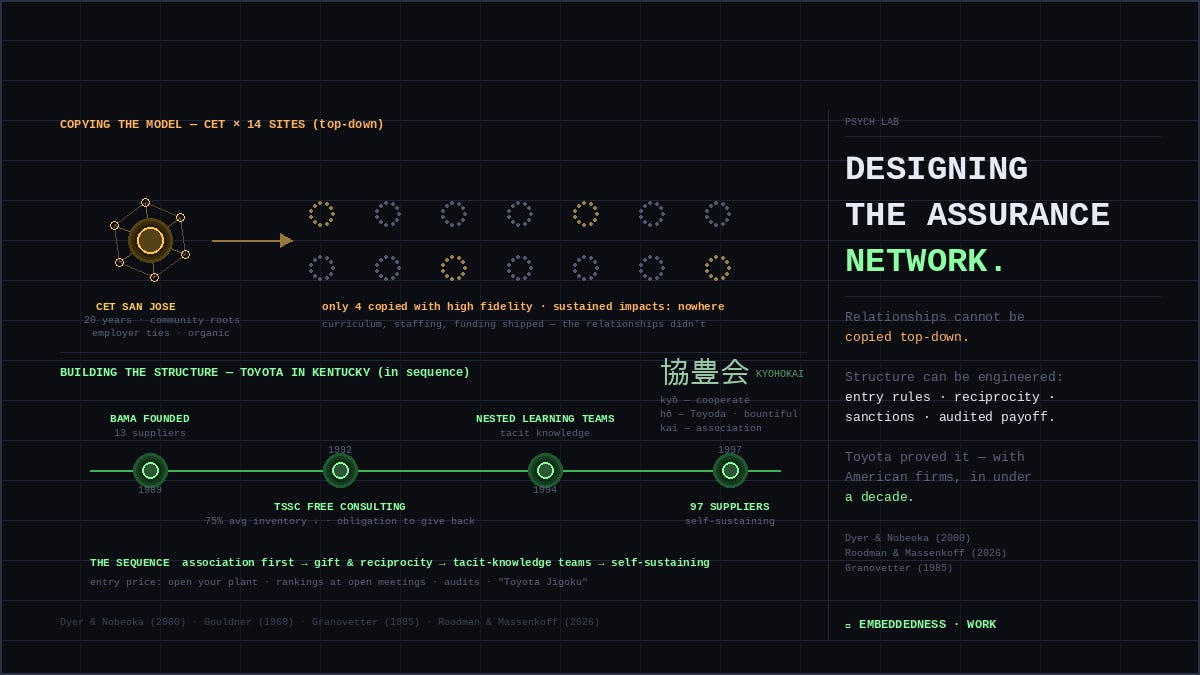
The Center for Employment Training (CET) was a San Jose training provider that grew out of farmworker organizing in the late 1960s. In the randomized Minority Female Single Parent demonstration, it produced the standout results of its era, raising employment from 57% to 66% and monthly pay from $405 to $506 in the final follow-up year. It stood out again in a second randomized trial with young dropouts, adding $250 a month against controls (Burghardt et al., 1992, and Cave et al., 1993, as reported in Roodman & Massenkoff, 2026). Impressed, the Department of Labor replicated the model at fourteen sites across the country. However, only four replication sites were judged to have copied the model with high fidelity, and sustained impacts failed to materialize anywhere. The report concluded that CET-San Jose grew organically over twenty years within a dense web of ties to local employers and community organizations. A homegrown model like this perhaps “cannot be easily exported in a top-down way” (Roodman & Massenkoff, 2026). The replication sites received the curriculum, the staffing model, and the funding, but what they lacked were the embedded relationships.
However, interpersonal trust alone does not explain what could make retraining gain traction. Mark Granovetter’s (1985) theory of embeddedness shows us that economic life runs on networks of concrete relationships because networks carry the two assets certificates lack: word of mouth and reputation. Social capital is built in embeddedness and longevity at a company or in a network. An American employer trusts a hire the way Granovetter proposes, which is through relational information: the reference of who sent the candidate and, if applicable, who was referred to them prior by the same individual.
The Power of Embeddedness: Importing the Toyota Model
The case of Toyota illustrates the power of embeddedness (see case study, Dyer & Nobeoka, 2000). Its suppliers belong to an association called the Kyohokai, a name intentional in its construct of the Japanese lifetime employment structure and where assurance lies. Kyohokai breaks down to three characters:
Kyō (協): Cooperation, mutual help, or collaboration.
Hō (豊): Taken directly from the first character of Toyota’s original family name, Toyoda (豊田). It means bountiful, rich, or plentiful.
Kai (会): Association, group, club, or assembly.
The literal translation of Kyohokai is “Cooperate with Toyota”, with the abundance in its name sitting within the name of TOYODA. Researchers Dyer and Nobeoka (2000) showed how this network solved the problems that can kill most consortia, all of which illustrate how “structural assurance” operates: graded entry for newcomers, an obligation to give knowledge back after receiving free consulting, and sanctions against free-riding. Lastly, membership becomes very valuable because member suppliers in the Kyohokai improve productivity measurably faster than outsiders.
The strongest part of the case is the part usually left out: Toyota rebuilt this structure in Kentucky, with American firms, in under a decade. Its US supplier association, BAMA, began in 1989 with 13 suppliers and grew to 97 by 1997; the free consulting arm, TSSC, followed in 1992 and averaged 75 percent inventory reductions across its first 31 completed projects; small learning teams came in 1994 (Dyer & Nobeoka, 2000). The sequence was deliberate: the association first, to build social ties among suppliers who previously never called each other; then free consulting, a gift that created a felt obligation to reciprocate in Gouldner’s (1960) sense; then nested teams for tacit knowledge. The price of entry was opening your own plant to other members, which the authors report essentially eliminated free-riding. Nor was the club warm: supplier performance was ranked at open meetings, audits verified that recommended changes were implemented, and Japanese suppliers call working with Toyota “Toyota Jigoku,” Toyota Hell. Sanctions and incentives, together, and supplier motivation measurably evolved from demonstrating loyalty toward seeking knowledge and reciprocity, at which point the network became self-sustaining. Granovetter would add one caution, which is that tight networks can also shelter collusion and exclusion, so a club needs governance.
Architecting the Future of AI Workforce Policy
America’s best retraining programs already show what that infrastructure looks like, in prototype. By the time a graduate reaches an employer, the screening process has already acted as a proxy for interpersonal trust. These programs further cultivate long-term relationships with specific employers and stake their reputation on every graduate, effectively serving as the guarantor that an isolated certificate lacks. This structural reliance on embedded networks explains why these models resist replication. When the Department of Labor copied the most famous of them across fourteen sites, the sites failed because they lacked the local relationships that built the foundation.
Therefore, the central design question for the next decade of retraining policy, accelerated by the rapid integration of artificial intelligence, is how to create networks resembling these structural features. This requires designing membership structures with entry rules, reciprocity obligations, sanctioning power, and audited evidence that belonging to it is valuable, ensuring a certificate carries economic weight. As Toyota illustrates, the essence of this structural assurance can be codified. Retraining begins with trust, but the structure of trust is culturally constructed and specific. Because the anchor and production of trust varies country by country, frontier AI labs designing next-generation retraining initiatives must account for the embeddedness that resonates with each location.
References
Akerlof, G. A. (1970). The market for “lemons”: Quality uncertainty and the market mechanism. Quarterly Journal of Economics, 84(3), 488-500.
Delhey, J., Newton, K., & Welzel, C. (2011). How general is trust in “most people”? Solving the radius of trust problem. American Sociological Review, 76(5), 786-807.
Doi, T. (1973). The anatomy of dependence. Kodansha International.
Dyer, J. H., & Nobeoka, K. (2000). Creating and managing a high-performance knowledge-sharing network: The Toyota case. Strategic Management Journal, 21(3), 345-367.
Gouldner, A. W. (1960). The norm of reciprocity: A preliminary statement. American Sociological Review, 25(2), 161-178.
Granovetter, M. (1985). Economic action and social structure: The problem of embeddedness. American Journal of Sociology, 91(3), 481-510.
Kahn, W. A. (2001). Holding environments at work. Journal of Applied Behavioral Science, 37(3), 260-279.
Kollock, P. (1994). The emergence of exchange structures: An experimental study of uncertainty, commitment, and trust. American Journal of Sociology, 100(2), 313-345.
Miller, C., Bos, J. M., Porter, K. E., Tseng, F. M., & Abe, Y. (2005). The challenge of repeating success in a changing world: Final report on the Center for Employment Training replication sites. MDRC.
Roodman, D., & Massenkoff, M. (2026). An evidence review of worker retraining. Anthropic Economic Index.
Yamagishi, T., & Yamagishi, M. (1994). Trust and commitment in the United States and Japan. Motivation and Emotion, 18(2), 129-166.
Yamagishi, T., Cook, K. S., & Watabe, M. (1998). Uncertainty, trust, and commitment formation in the United States and Japan. American Journal of Sociology, 104(1), 165-194.
Yuki, M., Maddux, W. W., Brewer, M. B., & Takemura, K. (2005). Cross-cultural differences in relationship- and group-based trust. Personality and Social Psychology Bulletin, 31(1), 48-62.
Zucker, L. G. (1986). Production of trust: Institutional sources of economic structure, 1840-1920. Research in Organizational Behavior, 8, 53-111.