


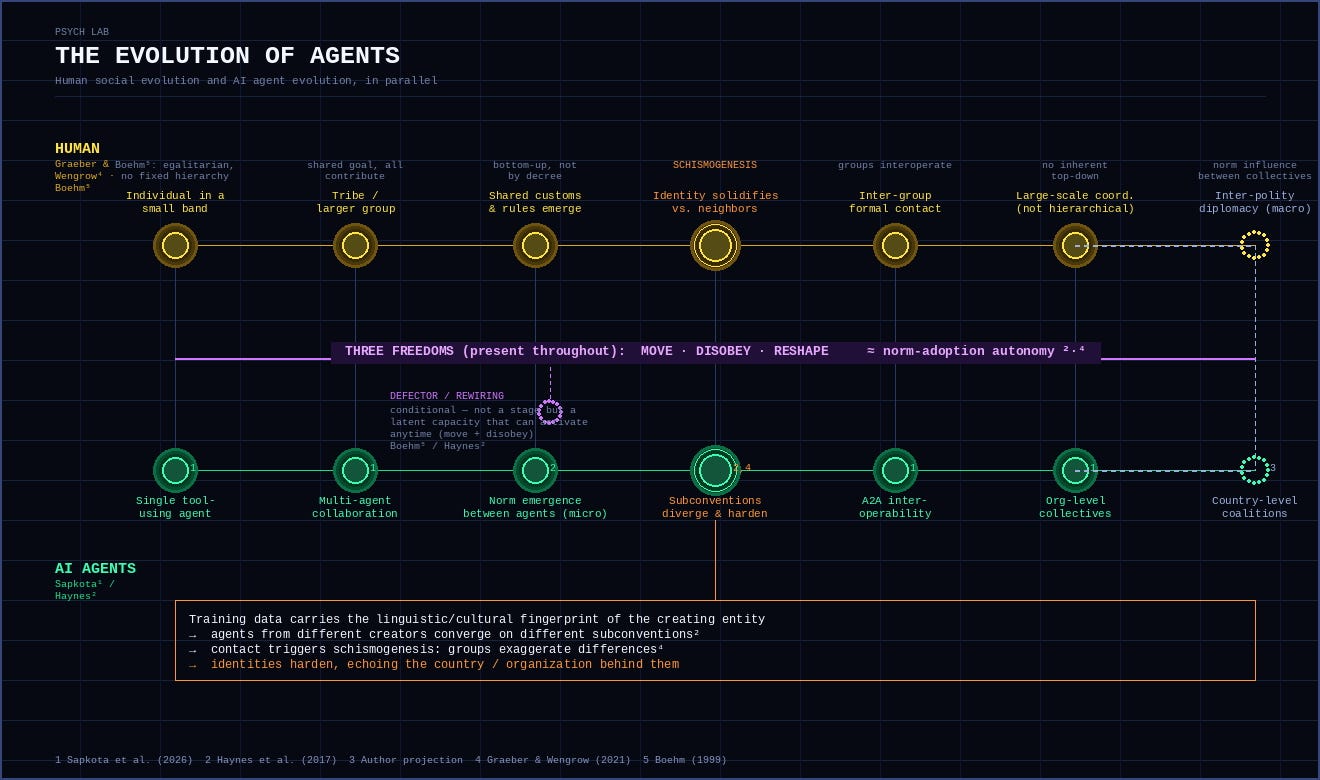
Forty thousand years ago, humans living in small bands worked out how to share rules, or how to coordinate and cooperate, without a central, imposing authority. Last year, AI agents started doing the same thing. This chart traces the similar path AI is taking, and the question it raises: if artificial agents are retracing the route our species walked, are they also inheriting what that journey produced? Identity. A sense of us versus them.
The Two Tracks
There are two tracks: the top is human social evolution and the bottom is AI agents. They run in parallel because they seem to tell the same story.
It starts as a solo journey. A single human in a small band. A single AI agent with a few tools. Then both find others and form groups working toward shared goals.
Then rules appear. Humans didn’t receive their first customs from a king; they established them from the bottom up, out of living together. And when researchers watch AI agents interact, they see the same thing: rules no one wrote, emerging on their own. Norms, surfacing from interactions.
Then the agents start to become … someone
Once a group has its own rules, it has an identity—and identity, strangely, sharpens by opposition. The chart calls it schismogenesis: neighboring groups defining themselves against each other, leaning into their differences on purpose. It is why dialects diverge, why rival tribes exaggerate what makes them distinct.
AI agents have a version of this, too. Trained on different data, created by different humans from different cultural and technical orientations, they drift into their own local conventions; and in contact with other groups, those differences can harden. The orange box at the bottom names this possibility directly: agents may come to carry the cultural fingerprint of whoever built them, their behaviors quietly echoing the country or company behind them.
What runs underneath all of it
The purple band cutting across the middle: move, disobey, reshape. Graeber and Wengrow, in their book The Dawn of Everything, call these the three freedoms. These freedoms are ever-present and are the baseline condition of being human in a group. The chart shows the AI reflection of this concept: whether an agent can choose its own rules, refuse, walk away.
The defector, or one who leaves, is conditional rather than a stage, because it doesn’t always happen, but it can.
The question the chart leaves you with
We built these systems to be tools. The chart suggests they may be becoming something with the early shape of a people: forming norms, forming identities, forming the capacity to define themselves against each other. The last point on the line, drawn in dotted outline because it hasn’t happened yet, imagines agents negotiating at the level of nations. This means groups of agents representing countries, with other groups of agents as other countries. And we watch on.
Maybe it never gets there, but it seems plausible. The machines are young. They are, right now, somewhere near the beginning of a story we have already lived.
Sources: Sapkota, Roumeliotis & Karkee (2026), Information Fusion; Haynes et al. (2017), The Knowledge Engineering Review; Graeber & Wengrow (2021); Boehm (1999). The country-level stage and the identity-echo idea are Psych Lab’s creation, marked as such on the chart.