


Agentic AI harbors the seductive premise that scaled intelligence can route around the vulnerabilities that define humans as a species: our capacity for moral deliberation. What remains is a system that executes without second-guessing, friction, or the weight of human deliberation.
It is a compelling vision. It is also built on a fundamental misunderstanding of what artificial intelligence actually is.
Where AI Lives
Researchers* spent the past few years studying how AI actually functions in organizations: in hospitals, police departments, and ridesharing platforms. What they found challenges mostly everything the mainstream conversation about AI assumes.
They argue that AI is not a sovereign intelligence waiting to be unleashed by better hardware or larger models. Instead, it is an organizing capability that emerges from the active relationships between human and algorithmic actors, enacted in practice, over time, toward shared goals. Most importantly, their vision of AI is one where it is an intelligence produced between humans and machines, together, continuously.
Codependence, A Good Thing (For once)
Here is the most counterintuitive idea about AI: AI requires codependence. The organizing capability of AI is one that is codependent on both human and algorithmic actors. Neither is sufficient alone. The learning algorithms that underpin AI can process vast amounts of data, identify patterns, and optimize toward defined goals with a speed and precision no human can match. But they cannot set those goals, exercise moral judgment, or orient the system toward human flourishing rather than narrow optimization. Their learning is entirely bounded by the data and objectives that human actors supply.
The algorithm doesn’t disappear when humans disengage, but the intelligence does. What remains is a technical artifact, capable of computation, but absent of the organizing capability that makes AI so useful. For example, when radiologists in hospital settings disengaged from algorithmic recommendations by bypassing the system rather than interrogating it, AI is absent. The algorithmic system was present, but the intelligence of AI was not. Decisions reverted entirely to human actors. AI emerges in the friction of collaboration and reflection of the human.
Life in a Post-AI World
This is where recent research becomes the most interesting for trying to answer the question of what makes a human life worth living in a post-AI world.
The qualities the tech sector most eagerly frames as liabilities: human doubt, moral hesitation, the tendency to pause and question, are turning out to be more structurally necessary (and protective) than assumed. The moments of human friction, of professionals choosing to interrogate algorithmic recommendations rather than accept passively, are the moments we recognize our own value as distinct from the organizing capability of AI. This is where AI’s intelligence emerges through the friction of the human pause and reflection; a collaboration with AI that acts as a catalyst for transforming AI from just an organizing capability to intelligence.
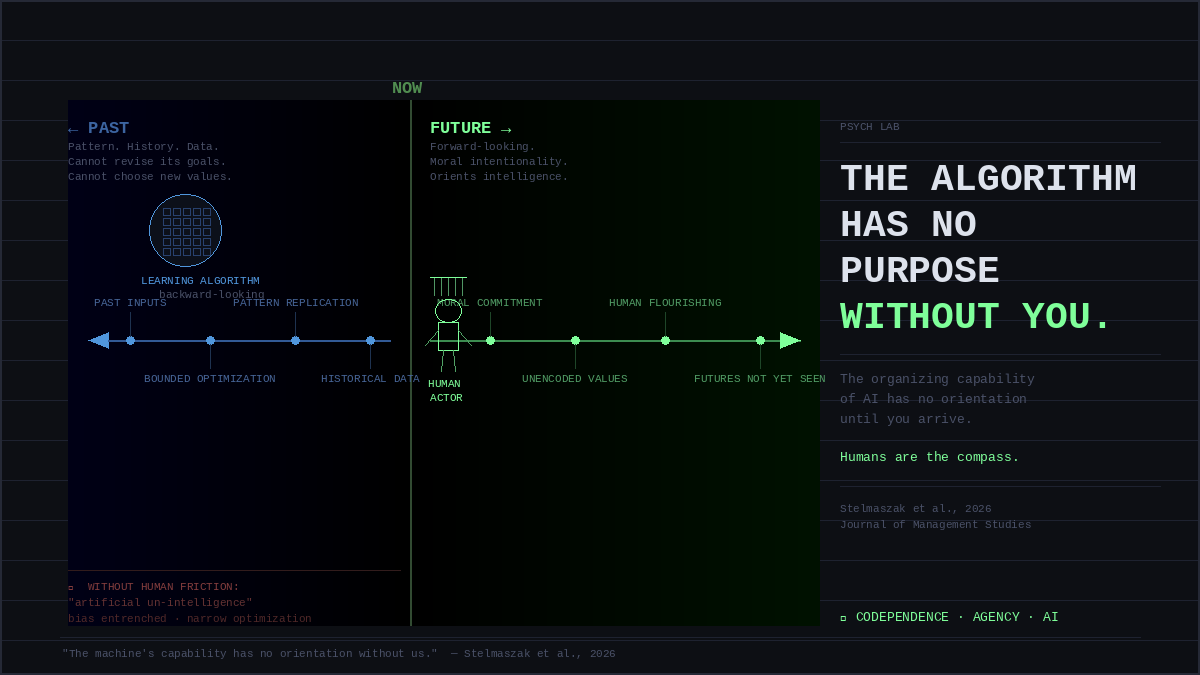
When the human-algorithmic feedback loop runs without adequate moral friction, it doesn’t become more intelligent. It becomes what researchers call “artificial un-intelligence,” or systems that entrench flawed assumptions, amplify biases, and optimize for narrow objectives at the expense of broader human goals.
All that AI Cannot Do
There is a dimension of human experience that no algorithm can provide. By nature, learning algorithms are backward-looking. They learn from historical data, replicate statistical patterns, and optimize toward goals they did not choose and cannot revise. Even the most sophisticated generative AI systems are recombining patterns learned from the past. Values not yet encoded in a dataset are out of reach. While AI systems can simulate futures based on historical patterns, they cannot choose to orient themselves toward futures that conflict with their training data or step outside of those goals to question if they were worth pursuing in the first place. That reorientation, which is a symphony of intrinsic sensing and somatics, belongs to human actors.
Faith in what has not yet been, moral intentionality toward goals too broad for optimization targets (think of a doctor choosing to prioritize a patient’s dignity over a statistically optimal treatment protocol, or a policymaker refusing an efficient algorithmic recommendation on the grounds that it encodes historical injustice), for the willingness to act on values under conditions of genuine uncertainty, belong exclusively to the human actors in the system. These are structural features of what intelligence requires in order to have direction rather than just momentum.
A Different Answer to an Old Question
The tech sector’s implicit answer to the question of what makes a human life worth living looks something like this: maximal output, minimal friction, optimized execution. Agentic AI attempts to extend this logic; systems that act with increasing autonomy, decreasing need for human input, and seamless achievement of predefined goals.
Research suggests a different answer: a human life is made worth living by the irreplaceable role we play as the moral anchors of the systems we inhabit together. Our vulnerabilities, doubts, and capacity for moral friction, are how intelligence remains human.
The organizing capability of AI is incomplete without human actors, and never quite rises to “intelligence”. Stewardship, with all of its friction, may be the closest we get to answering what makes a human life worth living.
*Stelmaszak, M., Joshi, M., & Constantiou, I. (2026). Artificial intelligence as an organizing capability arising from human-algorithm relations. Journal of Management Studies, 63(2). https://doi.org/10.1111/joms.70003