


What if the key to ethical design isn’t removing friction—but designing the right kind of it?
Below are the top 5 ways designers and researchers can strategically reintroduce friction into AI systems and digital platforms to prompt reflection, resist manipulation, and empower agency.
Whether you're working on nudges, recommender systems, ethical frameworks, or user journeys—this is your friction-forward guide.
Creative Friction: Design Strategies
1. Nudging vs. Friction: When Disruption Enhances Clarity
Key insight: How nudging and design friction influence user cognition.
- Design friction introduces “breakpoints”, which are interruptions that help users exit automatic behaviors.
- In lab tests, adding friction (e.g., an extra confirmation step) increased decision accuracy by 33%.
- Sundin argues friction is essential in contexts requiring responsibility, such as digital consent or financial commitments.
📍 Example: A dialog box before data-sharing boosted opt-out rates from 18% to 42%.
📖 Reference: Sundin, E. (2021). Nudging and Design Friction: The Impact on Our Decision-Making Process.
2. Reflective Nudging: Slowing Down to Make Better Choices
Key insight:
This ACM study introduced “reflective nudges”—design elements that delay or obstruct interaction to promote conscious choices.=
- Micro-frictions tested: delayed buttons, mandatory justifications, visual disfluency
- A 1.5-second delay reduced impulsive posts by 41%
- Requiring a reason before deleting increased content retention by 22%
📍 Example: “Pause before posting” reduced hate speech in 14 of 20 participants.
📖 Reference: Mejtoft, T., Parsjö, E., & Norberg, O. (2023). Design Friction and Digital Nudging: Impact on the Human Decision-Making Process.
3. Smart Nudging with AI: Context-Aware Friction Modulation
Key insight: This 2023 experiment introduced AI-driven smart nudging that adapts interface friction based on context and risk. They propose “context-aware friction modulation”, where the system senses urgency and adapts interaction layers.
In financial app experiments, increased friction during high-risk choices (e.g., investments) led to:
-A 27% increase in decision confidence
-A drop in post-action regret from 21% to 8%
📍 Example: A trading app requiring double-confirmation on high-volatility stocks reduced risky trades by nearly a third.
📖 Reference: Mele, C., et al. (2021). Smart nudging: How cognitive technologies enable choice architectures.
4. Transparent Nudges and Trust: Clarity Builds Confidence
Key insight: Leimstädtner and Sörries studied how friction transparency affects user trust and decision quality.
- Explicit friction explanations (e.g., “this delay helps you reflect”) boosted trust by 19%
- “Type II” nudges—those that are overt—resulted in better memory retention and ethical alignment
📍 Example: In a health app, delaying a decision to share sensitive data with a justification message led to a 34% decrease in sharing but a significant increase in user trust.
📖 Reference: Leimstädtner, D., & Sörries, P. (2023). Investigating Responsible Nudge Design.
5. Digital Well-being Friction: Mindful Interruptions for Addictive UX
Key insight: Zaheer tested frictional interventions in popular mobile apps to support digital wellness.
A “3-second reflection prompt” in a social feed led to:
24% reduction in continued scrolling
38% of users reporting increased mindfulness
“Break nudges” (e.g., “You’ve been on for 15 minutes—want to pause?”) were well-received, with positive UX scores improving by 16%.
📍 Example: Asking “Why are you opening this app?” caused 1 in 5 users to quit mid-session.
📖 Reference: Zaheer, S. (2024). Designing for Digital Well-Being.
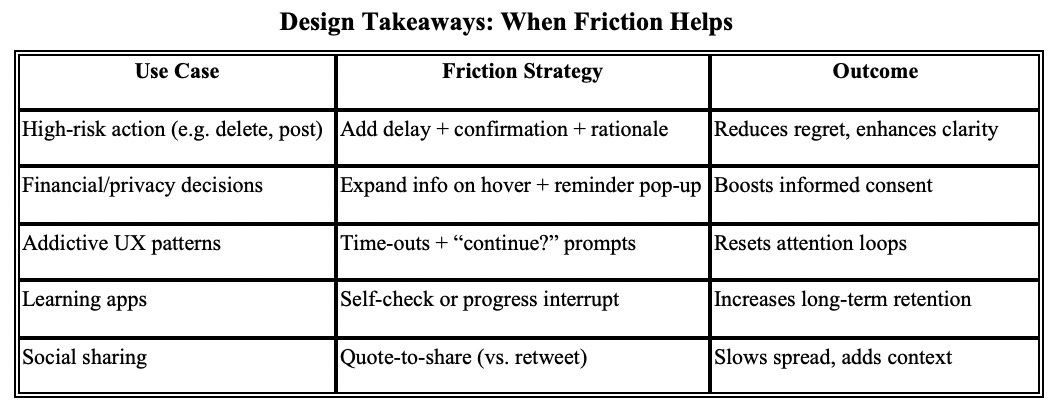
Final Thought: Design Takeaways
References
- Sundin, E. (2021). Nudging and Design Friction: The Impact on Our Decision-Making Process. Conference in Interaction Technology and Design.
- Mejtoft, T., Parsjö, E., & Norberg, O. (2023). Design Friction and Digital Nudging: Impact on the Human Decision-Making Process. Proceedings of ACM CHI.
- Mele, C., Spena, T. R., Kaartemo, V., & Marzullo, M. L. (2021). Smart nudging: How cognitive technologies enable choice architectures. Journal of Business Research, 129, 902–912.
- Leimstädtner, D., & Sörries, P. (2023). Investigating Responsible Nudge Design. ACM.
- Zaheer, S. (2024). Designing for Digital Well-Being.