


📊 Behavioral Design in Action: How to Run the Fresh Start Experiment for AI Adoption
What if the timing of your AI app launch mattered as much as the technology itself? Behavioral science suggests it does. This experiment tests a simple idea: nudging users to engage with AI tools during natural “fresh start” moments—like the New Year or their birthday—can significantly improve long-term adoption.
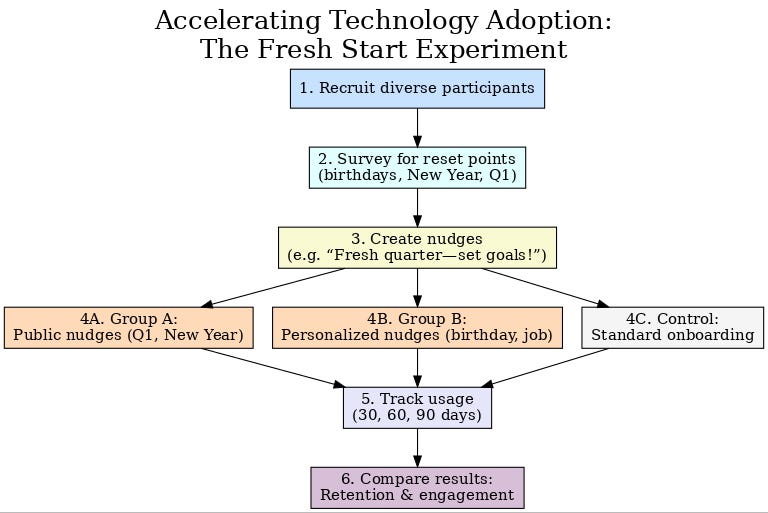
In this hypothetical design, 600 participants are recruited and then divided into three randomized groups. The Control Group (CG) receives standard onboarding only. Focus Study (FS) Group A receives nudges at public temporal landmarks like New Year’s Day or fiscal Q1. FS Group B receives personalized nudges tied to birthdays, new jobs, or project starts. Track app usage over 90 days using metrics like login frequency, report generation, and feature adoption. Let’s take a deeper look:
Overview: Testing whether aligning AI app engagement nudges with personal or cultural “reset points” improves long-term usage.
Step-by-step:
1. Recruit participants across a diverse professional population.
2. Survey for personal milestones (birthdays, anniversaries, etc.) and record major calendar resets (Jan 1, Q1, etc.).
3. Develop nudges (e.g., “It’s a fresh quarter—let’s set your goals”) and automate delivery.
4. Monitor usage metrics for 30, 60, and 90 days.
5. Compare retention and engagement across groups.
The most impactful fresh start trigger? Research by Dai, Milkman, and Riis (2014) identifies the New Year as a particularly potent motivational reset point—marking both a cultural and psychological boundary that signals “a clean slate.” Aligning AI app nudges with the New Year taps into broad societal momentum and existing goal-setting behavior, increasing the odds that users will engage with and retain the technology. This makes Q1 campaigns a strategic opportunity for rolling out or relaunching digital tools requiring consistent interaction.
📚 APA References
• Dai, H., Milkman, K. L., & Riis, J. (2014). The fresh start effect: Temporal landmarks motivate aspirational behavior. Management Science, 60(10), 2563–2582. https://doi.org/10.2139/ssrn.2294674
• Duong, C. D. (2024, June 12). What makes for digital entrepreneurs? The role of AI-related drivers for nascent digital start-up activities. European Journal of Innovation Management. https://doi.org/10.1108/ejim-02-2024-0154
• Gupta, V., & Yang, H. (2024, January 5). Generative Artificial Intelligence (AI) Technology Adoption Model for Entrepreneurs: Case of ChatGPT. Journal of Global Information Management. https://doi.org/10.1080/10875301.2023.2300114